

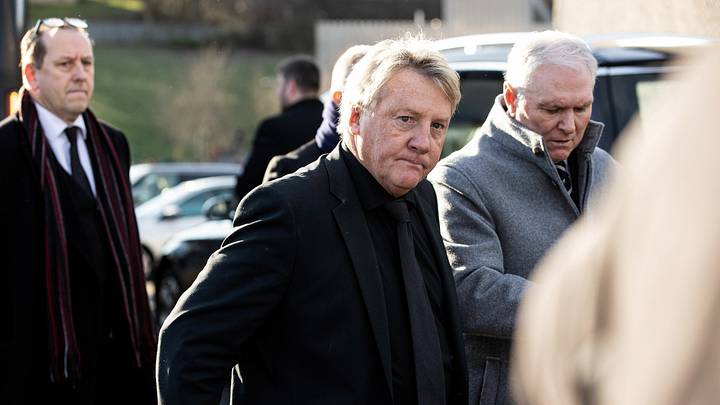
Frank McAvennie has taken a hammering online for his comments on Celtic defender Auston Trusty, but once again the criticism has gone too far.
McAvennie made headlines during the week for questioning how much time Celtic defender Auston Trusty took off from work following the death of his father.
Trusty was given initial time off following the passing of his father and was then given additional time off to attend the celebration of his father's life.
Celtic boss Martin O'Neill, who granted the time off, hit back at McAvennie, saying: "He's 28 years of age. And he's taken it badly. Honestly. I've afforded him all the time he wants.
"At some stage, obviously, he'll be coming back. But at the end of the day, I've given that time because I know that we might be talking about different eras or whatever the case may be. That's nothing to do with it. This is a family thing. And that's not right. So, Trusty has got the time and he's got the backing of myself and he's got the backing of the club."
Before the comments from O'Neill, McAvennie issued two statements, an initial statement where he failed to apologise and a second that acknowledged that the first did not go far enough, and he added an apology.
Criticism of McAvennie's comments is fair
First thing's first, the criticism of what McAvennie said is more than fair. It was beyond out of line and we wrote about it immediately upon seeing it.
Grief is personal and dependent on a myriad of factors. It's not only out of line for another person to question it, but it's impossible for them to truly understand it because, by nature, grief is so variable.
The use of the word 'woke' is also out of place and irrelevant in this situation, and it leads us to the conclusion that McAvennie was trying to create a controversial soundbite on his podcast.
What's unacceptable about that is that the intention becomes using the death of someone's father to create a podcast soundbite. Whether he realised it or not, that was the intention, and it is grossly unacceptable.
Then McAvennie posted a statement where he did not apologise, and it was along the lines of 'that's not how I meant it, and I can see why you didn't like it'. That reeks of stubbornness and a reluctance to apologise. Honestly, why do people have such a hard time apologising?
Crucially, though, the former Celtic defender did post a subsequent statement where he acknowledged the need for an apology and provided one.
Where the criticism crosses the line
On the back of the comments and the statements that followed, social media has been awash with criticism for McAvennie, and while lots of it is very fair, there is a large chunk of it that is very personal.
That's where this crosses the line. In this outrage culture we live in, people seem to think that a slip of the tongue or an offensive comment gives them the licence to personally attack the person who made it. It does not.
If you personally abuse someone for their offensive comment, you are no better, make no mistake.
Criticise the comments, criticise the attitude, and if you don't want to forgive McAvennie, feel free to hold a grudge by never watching another minute of his podcast. You are within your rights to do that.
But spending time trying to abuse him makes you a lot worse than the person who made a mistake by, quite frankly, talking rubbish on his podcast.
Have you never talked rubbish? Have you never tried to be funny or a little controversial on a topic and gone too far? If you haven't, you might as well be AI.
The man has apologised, and it is up to Trusty whether he forgives him. Equally, it is up to you whether you forgive him if he offended you. But if you think it gives you licence to become an abuser, you are sorely mistaken.
 Add us as a preferred source on Google